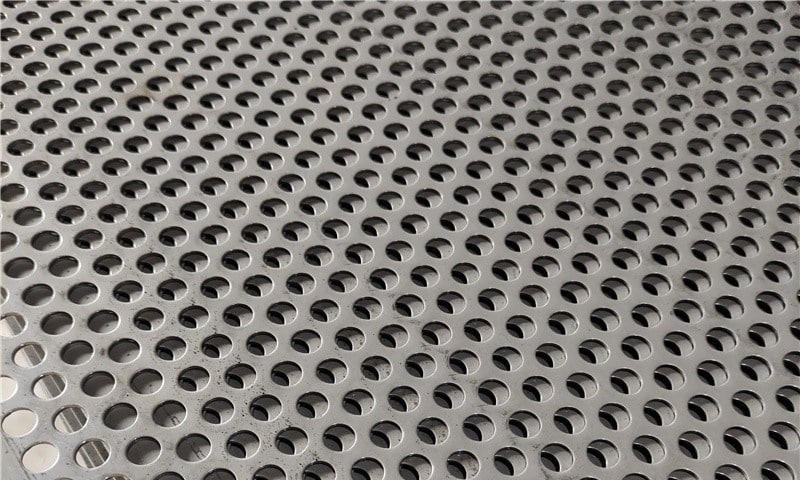
Why pitch (centers) matters for perforated aluminum sheets
Pitch — sometimes written as “centers” or “c/c” — is the center-to-center distance between adjacent holes in a perforated sheet. For engineers, purchasers, and fabricators this single number controls structural stiffness, open area, flow (air/liquid), and production cost. Get the pitch wrong and a part can fail a strength check, clog a filter, or simply cost more than it should.

Aluminum Perforated Metal Sheets
Send a Quick Message, We’ll Do the Rest
Tell us what you need. We’ll match the right perforated aluminum sheet and quote it — no back-and-forth.
Fast quote + lead time
Sample before production if needed
Factory direct pricing
How to read and write a pitch specification (quick reference)
Use a compact, industry-friendly format that gives hole diameter, pitch, pattern, and material/thickness. Examples engineers expect:
- Imperial (straight):
Ø3/16" x 5/16" c/c, straight, Al 0.080" - Imperial (staggered):
Ø3/16" x 5/16" c/c, staggered, Al 0.080" - Metric (straight):
Ø5 mm x 10 mm c/c, straight, Al 2.0 mm - Metric (staggered):
Ø5 mm x 10 mm c/c, staggered, Al 2.0 mm
Notes:
Øordia= hole diameter.xbetween diameter and pitch (e.g., Ø5 mm x 10 mm c/c) is standard shorthand.- Always state pattern (straight vs. staggered) and sheet thickness immediately after — these materially affect performance.
Straight vs. staggered patterns — practical differences
Straight (inline) pattern
- Holes line up in rows and columns.
- Produces the highest directional stiffness along rows; easier to machine and layout.
- Open area is predictable: simple area calculation (hole area × count).
- Typical use: architectural panels where visual regularity matters, or when directional strength is required.
Staggered (offset) pattern
- Every row is offset by half a pitch, creating a hexagonal-like packing.
- For the same pitch and diameter it gives ~15–20% more open area and better distributed load than a straight pattern.
- Often preferred for filtration, acoustic panels, and applications requiring greater open area without increasing hole diameter.
- Slightly more complex to punch but commonly available from experienced CNC punching shops.
Spec-writing tips for B2B purchasing and engineering
- Always give diameter, pitch (c/c), pattern, material grade, and thickness in the same line. Example:
Ø5 mm x 10 mm c/c, staggered, Al 5052-H32, t = 2.0 mm. - If tolerance is critical, append hole and pitch tolerances:
Ø5.00 ±0.05 mm, pitch ±0.10 mm. - Include required open area or max allowable open area if the design depends on flow or visual screening.
- For load bearing parts, request span-to-pitch guidance from the fabricator (we recommend limiting unsupported spans relative to pitch).
- Call out finishing (anodize, mill, powder coat) and post-forming. Perforation affects coating uniformity and paint adhesion.
One spec line you can copy into a PO or drawing
Imperial: Material: Aluminum 5052-H32, t = 0.080" (2.03 mm); Perforation: Ø3/16" x 5/16" c/c, staggered; Tolerances: hole ±0.005", pitch ±0.010"; Finish: mill.
Metric: Material: Aluminum 5052-H32, t = 2.0 mm; Perforation: Ø5 mm x 10 mm c/c, staggered; Tolerances: hole ±0.13 mm, pitch ±0.25 mm; Finish: mill.
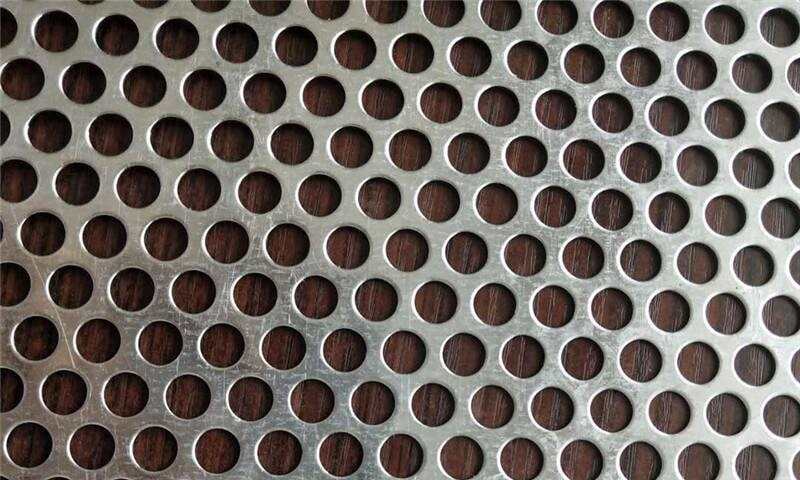
When to tighten pitch tolerances (and why)
Tighten pitch tolerances when parts stack, align with mating holes, or when vibration fatigue is a concern. Typical punching shops can hold pitch to ±0.10–0.25 mm (±0.004″–±0.010″) depending on hole size and material. Specify tighter only when necessary — tighter tolerances increase cost.
Market perspective: why buyers care about pitch beyond function
- Cost efficiency: Smaller pitch or smaller holes at the same open area requires more punching cycles and can raise price.
- Lead time: Custom pitches or exotic patterns may add setup time; standard pitches are faster to deliver.
- Supply chain: Standardizing a small set of pitches across product families reduces inventory and speeds quoting.
- Specification clarity: Clear pitch notation reduces RFIs, shortens quote cycles, and prevents costly rework.
Quick calculation — how pitch affects open area (rule of thumb)
- For round holes in a straight pattern: open area (%) ≈ (π × (dia/2)²) / (pitch²) × 100.
- For the same dia and pitch, staggered patterns yield noticeably higher open area — useful when you need flow without enlarging holes.
Wrap-up — a practical checklist before you buy
- Confirm hole diameter, pitch (c/c), and pattern.
- State material grade and thickness.
- Add tolerances only where necessary.
- Call out finish and any post-forming.
- Use this anchor for internal reference: perforated sheet pitch