Introduction: the practical case for steel perforated grating
When an industrial plant, refinery, or heavy-manufacturing facility needs a reliable walking surface, the choice often comes down to one balance: durability vs. cost. Steel Walkway Perforated Safety Grating sits squarely in that sweet spot — it gives engineers a high strength-to-weight solution that resists deformation under loads common to pedestrian and light equipment traffic, while remaining economically sensible for long runs of platforms and catwalks. For specifiers and plant managers this isn’t marketing copy — it’s about predictable performance, straightforward installation, and long-term lifecycle cost planning.
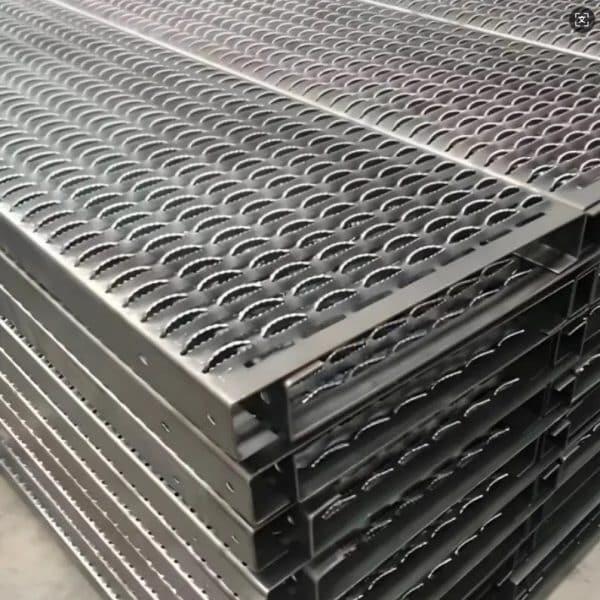
Perforated Safety Grating
Engineered perforated safety grating plate for industrial access systems.
Designed to provide slip resistance, drainage and structural strength in demanding environments such as manufacturing plants, utilities and processing facilities.
Commonly specified for:
- Stair treads and step assemblies
- Elevated walkways and access platforms
- Industrial ramps and service catwalks
Available in multiple metals and custom-fabricated to project requirements.
You can click on the product image to view the specific producible parameters or place an order.
Why carbon steel is the workhorse for walkways
Carbon (mild) steel is the default material for many perforated walkway plates and safety grating because it combines predictable mechanical properties, ease of fabrication (punching, forming, welding), and cost-efficiency compared with alloyed steels or specialty metals. Typical carbon-steel grades used in bar and plate grating are compatible with common structural specifications and can be produced to meet ASTM manufacturing tolerances for bearing bars and panels. Using carbon steel also simplifies sourcing and inspection: mill certificates and test reports are widely available for the grades engineers expect.
Practical benefits for plants and OEMs
- Predictable yield and tensile ranges — simplifies structural calculations and load checks.
- Easy punching and forming — perforated patterns for slip resistance and drainage are manufacturable in high volumes.
- Economies of scale — for long walkway runs, carbon steel panels usually give the best cost per square foot.
Balancing load capacity and cost — an engineer’s checklist
When specifying Steel Walkway Perforated Safety Grating, your decisions should be driven by load type (uniform pedestrian load vs. concentrated trolley or cart loads), span between supports, and allowable deflection.
Key design parameters
- Bearing bar size and spacing — heavier bearing bars and tighter spacing increase capacity but also raise material and weight costs. Use standard loading tables to convert service load into required bar geometry.
- Span and support pattern — shorter spans let you use lighter sections. If your design has long unsupported spans, choose deeper or closer-bearing bars.
- Deflection limits — for pedestrian comfort and mounted equipment, limit deflection to design criteria that the client or code presents (often L/100–L/240 ranges depending on application).
Cost trade-offs explained
- Upgrading bar thickness or reducing spacing increases upfront material and handling cost but reduces the risk of vibration, fatigue and maintenance later.
- In many production and warehouse applications, the correct choice is a modest increase in bearing-bar specification to avoid downtime from damaged gratings or accelerated wear — a classic operating-cost vs. capital-cost decision.

Surface treatments — protect the steel to extend useful life
Corrosion protection is where procurement teams can save money or create headaches if they take the cheap route. For walkways, three surface strategies dominate: hot-dip galvanizing, factory-applied powder coating or paint, and duplex systems (galvanize + topcoat).
Hot-dip galvanizing — durable, sacrificial protection
Hot-dip galvanizing applies a fused zinc layer that offers sacrificial corrosion protection and is well-proven for outdoor and high-moisture plant environments. It’s often the preferred option when long, maintenance-free life is important — especially for exterior platforms and coastal or chemical-exposure sites.
Powder coating / paint — cosmetic and targeted protection
Powder coats provide a tough, color-stable finish that’s attractive for visual differentiation (safety colors, company branding) and protects against surface corrosion — but if the coating is scratched and the underlying steel is exposed, corrosion can start under the film. For indoor or sheltered walkways where abrasion is limited, powder coat is an economical, clean-looking option.
Duplex systems — best of both worlds for harsh service
For projects that demand extended lifetimes, a duplex system (hot-dip galvanize followed by a factory topcoat or powder coat) significantly increases time-to-first-maintenance compared with either system alone. This approach is common on critical plant assets where repaint downtime is costly.
Specifying best practice — what to call out on drawings
To reduce ambiguity during procurement and installation, include these items on your specification or drawing notes:
- Material grade (e.g., mild carbon steel to ASTM A1011 / A36 where applicable).
- Bearing bar size and spacing; panel dimensions and direction of span.
- Loading criteria: uniform and concentrated loads with allowable deflection limits (reference the loading tables used).
- Surface finish: hot-dip galvanize, powder coat (specify color and film thickness), or duplex system.
- Edge and finish details: kickplates/toeboards, serrated vs. smooth perforation, and any slip-rating requirements for oily or wet environments.

Lifecycle thinking — maintenance, inspection, and TCO
The lowest upfront bid is rarely the lowest total cost of ownership. A simple lifecycle check-list:
- Inspect finishes annually in aggressive environments and after any mechanical damage.
- For galvanised surfaces, look for areas where coating is breached; for painted/powdered surfaces, check for under-film corrosion at scratches.
- Budget for periodic touch-up or localized repair rather than whole-system replacement — duplex finishes extend intervals between interventions, often justifying their higher initial cost.
Final recommendation for procurement teams
For most industrial walkways where durability, predictable load performance, and low maintenance are priorities, Steel Walkway Perforated Safety Grating made from carbon steel and finished with hot-dip galvanizing (or a duplex system where aesthetics and further protection are required) is a practical standard. It delivers the structural performance engineers trust and the lifecycle economics procurement teams need to justify choices to operations and safety stakeholders.
If you’re preparing a specification, start with clear loading and span requirements and request manufacturer load tables and mill/test certificates with the quotation — that’s the fastest way to compare apples-to-apples among vendors.