
Overview: a practical choice for price-sensitive, automated applications
Ferritic 430 stainless steel is a pragmatic option when you need a balance of magnetic behavior, decent indoor corrosion resistance, and lower material cost. For many B2B buyers — OEMs in appliance manufacturing, display and fixtures makers, and systems integrators working with automated sorting — 430 perforated sheets deliver measurable advantages when specified correctly.

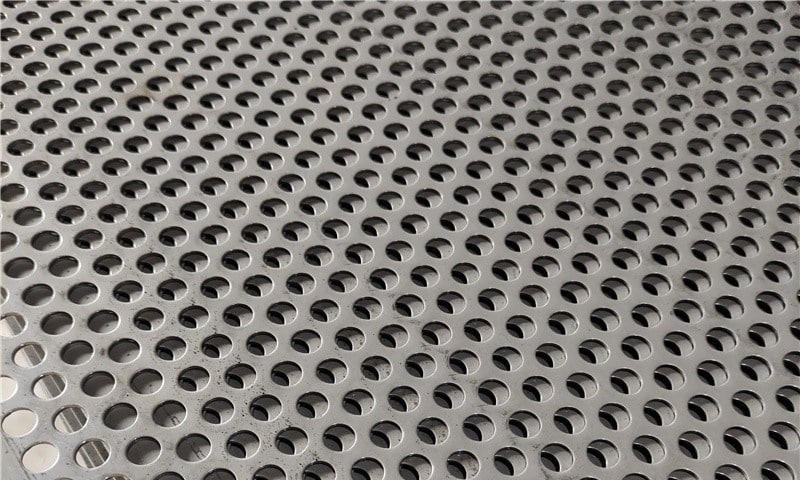
Stainless Steel Perforated Metal Sheets
Stainless steel perforated sheet is a commonly used material in both architectural and industrial applications. It offers stable corrosion resistance and good fabrication flexibility.
Hole patterns, open area, dimensions and surface finishes can all be customized according to project drawings. Typical uses include facades, ventilation and filtration, partitions and equipment protection.
Feel free to view the product details or contact us for samples and pricing information.
What “ferritic” means and why magnetism matters
Material basics
430 is a ferritic stainless steel alloy (typically chromium-bearing with little or no nickel). That ferritic microstructure makes the material magnetic at room temperature and gives it predictable mechanical behavior during punching and bending.
Why magnetism is useful in manufacturing and automation
Magnetic separation and detection are widely used on automated sorting lines, vending and dispensing equipment, and appliance assembly. Using a magnetic perforated panel — Ferritic Perforated Stainless Steel — allows:
- Reliable detection by simple sensors or magnets for part orientation and quality control.
- Integration with magnetic conveyors or separators without adding extra attachments.
- Cost-effective end-of-life recovery in recycling streams that rely on magnetic sorting.
Performance: corrosion and wear compared with 304
Indoor, dry environments — close performance
In indoor, dry conditions (warehouses, retail fixtures, appliance innards), 430’s corrosion resistance is often comparable in practical terms to 304 for many non-critical applications. While 304 is more corrosion-resistant in aggressive or humid environments, 430 stands up well when:
- Exposure is limited (indirect contact, indoor use).
- Protective finishes (polish, passivation) or coatings are applied.
- Design allows drainage and avoids water traps.
Limits to consider
Where chloride exposure, outdoor weathering, or long-term wet conditions are expected, 304 (or higher-grade alloys) remain the safer choice. For those use cases, specify 304 or duplex grades instead of relying on 430.
Cost profile and when 430 becomes attractive
430 is typically priced lower than austenitic grades because of its low or zero nickel content. This makes it attractive for:
- High-volume, price-sensitive components such as appliance inner drums, speaker grilles, retail shelving, and point-of-purchase displays.
- Projects where magnetic properties add functional value (e.g., fixtures that need to be held or detected magnetically).
- Applications where the end environment is controlled and the additional corrosion resistance of 304 is not required.
Typical applications for perforated 430 stainless sheet
Industry examples
- Appliance components (interior panels, support baskets) where magnetic recovery and lower cost matter.
- Display fixtures and merchandising racks used indoors.
- Machine guards and ventilation panels integrated into production lines with magnetic detection.
- Recyclable product parts where magnetic separation is part of the waste stream.
Design and fabrication notes for perforated panels
Punching and hole patterns
Ferritic stainless steels punch cleanly with the right tooling and clearance. Common hole shapes — round, slotted, hex, serrated — can be produced with high repeatability. Consider:
- Hole diameter to sheet thickness ratios to maintain structural integrity.
- Staggered vs. inline patterns for strength vs. open area balance.
- Edge relief and tumble/edge finishing to remove burrs.
Thickness, finish, and coating options
Typical perforated sheet thicknesses used in industry range from thin gauge panels for acoustic/ventilation uses to heavier gauges for structural panels. Common finishing choices:
- Mill finish or brushed finish for indoor aesthetics.
- Passivation to improve surface corrosion resistance.
- Powder coating or paint where color or additional protection is required.

Specification checklist for procurement teams
When specifying Ferritic Perforated Stainless Steel (430) buy side teams should list:
- Alloy grade (e.g., 430) and applicable material standard (if required).
- Sheet thickness tolerance and hole pattern details (type, pitch, open area %).
- Surface finish and any post-processing (passivation, deburring, coating).
- Required magnetic/detection performance (if used for automation).
- Environmental constraints (indoor/dry vs. outdoor/humid) to validate alloy choice.
Final recommendation — match material to environment and function
If your project is price sensitive, operates in controlled indoor conditions, and benefits from magnetic properties (sorting, detection, integration with magnetic systems), Ferritic Perforated Stainless Steel (430) is an excellent candidate. For humid, chloride-exposed, or safety-critical environments, evaluate 304 or higher grades instead.
Practical tip: when in doubt, request sample panels with your chosen hole pattern and finish — run them through your production/inspection line to confirm magnetic detection, fit, and corrosion behavior before full production.