Why Open Area in Perforated Aluminum Is More Than a Number
In real-world projects, open area perforated aluminum is rarely just a technical detail. It directly affects airflow, daylight transmission, acoustic response, and even how “dense” or transparent a panel looks from a distance.
In simple terms, open area—also called perforation ratio—refers to the percentage of total sheet surface that is occupied by holes. A sheet with 30% open area means that 30% of its surface is open space, and 70% remains solid aluminum.
From an engineering perspective, perforation ratio impacts:
- Air volume and static pressure drop
- Light diffusion and shading levels
- Weight reduction
- Structural integrity
- Acoustic absorption performance
From a market and architectural perspective, it determines:
- Visual density and privacy control
- Façade appearance at different viewing distances
- Code compliance for ventilation or screening
- Cost efficiency based on material removal and punching time
Over the years in CNC punching production, we’ve found that confusion around open area perforated aluminum often leads to over-specification—or worse, underperformance. Choosing the right range avoids both.

Aluminum Perforated Metal Sheets
Send a Quick Message, We’ll Do the Rest
Tell us what you need. We’ll match the right perforated aluminum sheet and quote it — no back-and-forth.
Fast quote + lead time
Sample before production if needed
Factory direct pricing
How Open Area Influences Air and Light Performance
Airflow & Ventilation
For HVAC screens, equipment enclosures, or machine guards, airflow performance is often the primary concern.
As a general reference:
- 10–20% open area → restricted airflow, higher pressure resistance
- 20–40% open area → balanced airflow and structural strength
- 40–60% open area → high airflow, lightweight panels
Higher perforation ratio typically reduces pressure drop, but the hole pattern, thickness, and sheet size all matter. A thin aluminum sheet with 45% open area behaves very differently from a thick structural panel with the same percentage.
When engineers evaluate open area perforated aluminum for ventilation, the decision should be based on airflow requirement (CFM), not appearance alone.
Light Transmission & Shading
For architectural façades and sunscreens, perforation ratio controls solar penetration.
- Low open area (under 20%) provides stronger shading and visual privacy.
- Mid-range (25–35%) offers balanced daylight control.
- High open area (40%+) allows significant light transmission and transparency.
Architects often test this with mock-ups because human perception of transparency is not linear. A panel with 30% open area can appear much more transparent than expected, depending on hole size and spacing.
Common Open Area Ranges in the Market
In North American B2B projects, these ranges are frequently specified:
15%–25% Open Area
Typical for:
- Privacy screens
- Interior design panels
- Acoustic backings
This range maintains high strength and gives a “solid” visual impression.
25%–40% Open Area
One of the most commonly specified perforation ratios.
Used for:
- Architectural façades
- Equipment covers
- Railing infill panels
- Sunshades
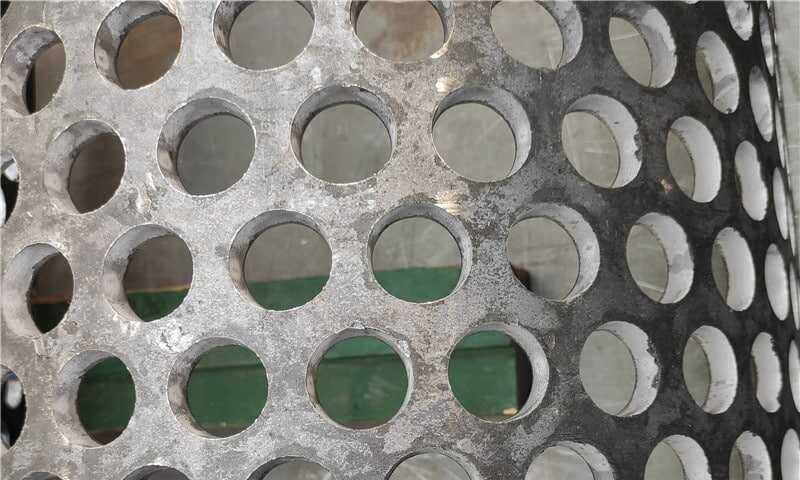
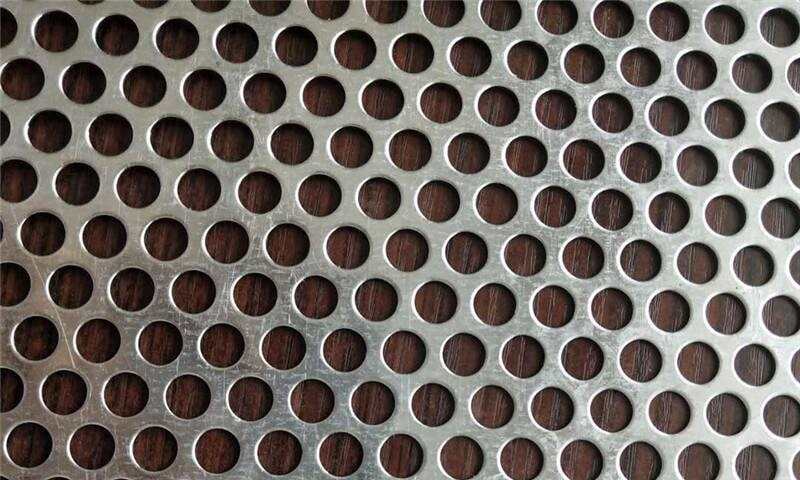
It balances airflow, visual aesthetics, and structural stability. Many standard round hole staggered patterns fall within this range.
40%–60% Open Area
Applied when:
- Maximum ventilation is required
- Weight reduction is important
- Transparent appearance is desired
However, material thickness and edge reinforcement become critical at this level to prevent deflection.
Understanding Visual Density vs. Actual Perforation Ratio
One common mistake is assuming that higher open area always looks more “open.” In practice:
- Small holes with tight spacing can look dense even with 35% open area.
- Larger holes with wider pitch may look visually open at only 30%.
This is why experienced manufacturers discuss both hole diameter and center-to-center spacing, not just perforation ratio.
In our CNC punching operations, we often recommend reviewing a physical sample. Digital renderings do not always reflect how light interacts with aluminum perforated sheets in real installations.
If you are comparing patterns, you may find it helpful to review our detailed guide on
open area perforated aluminum
to better understand calculation methods and typical configurations.
How to Choose the Right Open Area Without Guessing
When selecting open area perforated aluminum, we recommend a four-step approach:
1. Define the Primary Function
Is your project driven by airflow, lighting control, privacy, acoustics, or aesthetics? Rank them. Every perforation ratio involves a tradeoff.
2. Confirm Structural Constraints
Sheet thickness, panel size, framing method, and wind load requirements will limit how high your perforation ratio can go.
Higher open area reduces rigidity. Engineering review is essential for façade applications.
3. Align With Code and Performance Specs
Some ventilation systems require minimum free area. Acoustic systems may require specific backing percentages. Always match perforation ratio with documented performance targets.
4. Request Sample Panels Before Mass Production
For B2B overseas clients, we routinely ship sample sections before final punching runs. This avoids costly production adjustments and ensures the open area performs as expected in real conditions.
Experience Matters in Perforated Aluminum Manufacturing
Perforation ratio selection is not just math—it’s practical manufacturing experience. Punch tooling wear, burr control, material flatness, and tolerance management all affect final panel quality.
A well-designed open area perforated aluminum panel should:
- Maintain dimensional accuracy
- Minimize distortion
- Optimize punching efficiency
- Deliver consistent hole alignment
In large-scale industrial and architectural projects, small percentage differences can have measurable cost and performance implications.
Final Thoughts: Choose With Data, Not Assumptions
Open area directly influences performance, appearance, and cost. The right perforation ratio depends on how your aluminum perforated sheets will function in the field—not just what looks good in drawings.
If you define airflow targets, lighting goals, structural limits, and aesthetic intent early, selecting the correct open area range becomes a technical decision—not a guess.
That’s how experienced teams approach it.