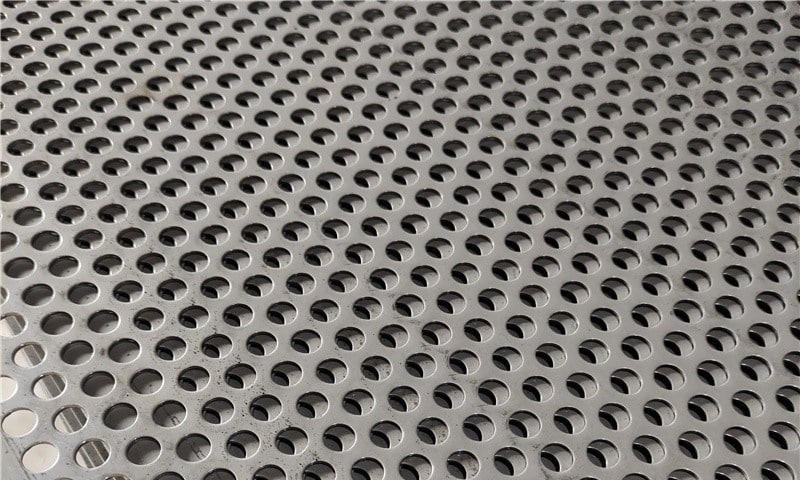
Introduction — why hole consistency matters in industrial filtration
In industrial filtration systems, small differences add up fast. Filter performance isn’t just about material choice or open area percentage — it’s fundamentally governed by the uniformity and repeatability of each hole in the media. Precision Stainless Steel Round Hole Perforated Sheets give engineers predictable flow paths, even particle loading, and a longer service life for filter cartridges and welded filter assemblies. This article walks through the technical and commercial reasons to specify tight hole control, and practical steps your procurement or engineering team can use to reduce downtime and total cost of ownership.

Round Hole Perforated Metal Sheets
Custom perforated metal sheets with precise hole patterns in various materials: stainless steel, aluminum, galvanized steel, carbon steel, copper, brass, and plastic. Durable and corrosion-resistant.
Perfect for architectural screens, machinery guards, acoustic panels, and decorative elements. Factory-direct pricing with cutting/bending services. Request quote or sample today.
The problem: what inconsistent hole geometry does to filters
Uneven flow and localized loading
When hole diameters or roundness vary across a sheet, flow concentrates through the largest or most poorly deburred openings. The result is uneven particulate loading, accelerated local clogging, and higher initial pressure differentials.
Mechanical and corrosion consequences
Non-uniform holes increase the chance of sharp burrs or micro-cracks at punched edges. Those defects accelerate fatigue under cyclic loading and can act as initiation sites for corrosion, especially in aggressive process fluids.
How manufacturing controls hole consistency
Primary factors that determine hole accuracy
- Tooling and punch condition: hardened tooling with precise die/punch clearance produces cleaner, more repeatable holes.
- Machine control and feed accuracy: CNC-controlled punching systems (or precision laser/punch hybrid lines) maintain positional accuracy and repeatable stroke, which reduces scatter in hole placement and diameter.
- Material handling and flatness: pre-leveling and controlled coil handling reduce springback and distortion during punching.
- Secondary finishing: deburring, passivation, and electropolishing remove burrs and reduce surface stress concentrators that shorten filter life.
Process best practices (engineering perspective)
- Implement a preventive maintenance schedule for punches/dies and monitor tool wear.
- Specify acceptable tolerances and roundness targets up front on the drawing (include open-area and maximum burr height).
- Use statistical process control (SPC) to track critical dimensions and react to drift before parts go out of spec.
- Consider secondary finishing where surface integrity is critical — e.g., electropolish for food, pharma, or high-corrosion environments.

Material and design trade-offs for filtration applications
Grade selection and corrosion considerations
For many industrial filters, 304 stainless steel balances cost and general corrosion resistance. For chloride- or chemical-exposed environments, 316 or specialty alloys deliver improved longevity at a higher material cost. Match alloy selection to process chemistry and expected lifetime to avoid early replacements.
Sheet thickness, open area, and structural support
Thicker sheets and proper backing structures increase mechanical strength but reduce open area for a given hole diameter. Design for the system-level trade-off: structural stiffness vs. hydraulic flow and cleanability.
Testing and qualification to prove longer service life
Dimensional and optical inspection
Optical metrology (camera-based systems) and coordinate measurement on sample parts verify hole diameter, positional tolerance, and roundness. Include measurement protocols in supplier qualification.
Functional / flow testing
Real-world flow testing with representative solids and backpressure conditions is the ultimate proof: measure pressure-drop evolution over time, particle retention, and clean-back performance to quantify predicted service life improvements.
Commercial perspective — how tighter tolerances pay off
Shorter-term cost-per-part can be tempting, but purchasing low-cost perforated sheets with wide variability often increases lifetime operating costs: more frequent cartridge replacements, higher labor for changeouts, and unexpected downtime. For B2B procurement, evaluate suppliers by lifecycle cost, the supplier’s QA practices, and availability of test reports — not just unit price.
Practical checklist for buyers and engineers
- Provide a clear drawing with: hole diameter, positional tolerance, roundness requirement, maximum burr height, and desired open area.
- Request sample panels and dimensional inspection reports.
- Ask about tooling maintenance frequency and whether tools are dedicated to your job.
- Confirm availability of secondary finishes (deburr, passivate, electropolish) and their lead times.
- Require SPC or acceptance sampling plans as part of the purchase order.
Case note — small change, big impact
In one typical retrofit we see in filtration lines, tightening hole diameter variability and adding a light electropolish step reduced localized plugging and extended filter runtime by a measurable percentage — lowering scheduled downtime and spare inventory needs. Those savings compound quickly across multi-line operations.
Conclusion — specify for performance, not just price
When your application depends on sustained particulate control, choosing Stainless Steel Round Hole Perforated Sheets manufactured under disciplined process control is a performance decision that affects uptime, maintenance cadence, and total cost of ownership. Ask suppliers for measurable evidence — dimensional reports, flow test data, and defined finishing procedures — and build those requirements into your procurement specs.