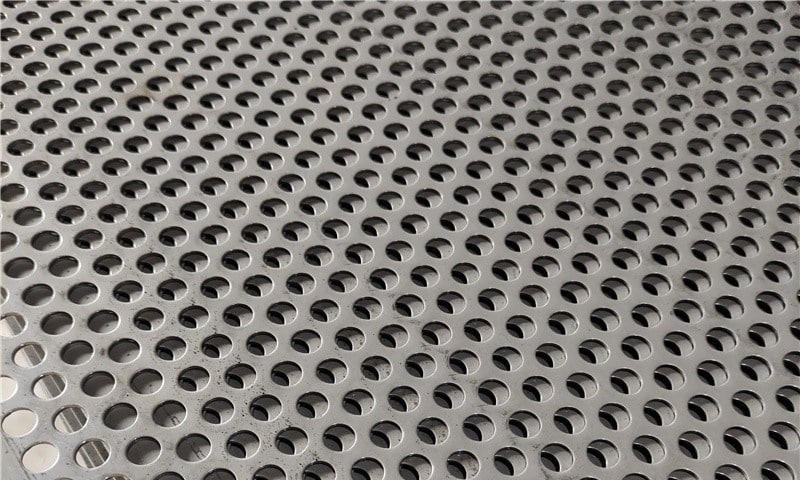
Perforated metal plates are everywhere — screening, filtration, architectural facades, machine guards, and heavy-duty industrial screens. When the base material is Q345B, its chemical composition plays a major role in how well a perforated plate stands up to abrasion, impact and long-term wear. This article walks through the most important elements in Q345B, how each one affects wear resistance, how perforation and fabrication change real-world performance, and practical recommendations to help buyers specify the right perforated plate for wear-critical applications.
Quick primer: what Q345B is and why chemistry matters
Q345B is a commonly used structural carbon-manganese steel grade. In plain terms, it’s a low-alloy structural steel that balances strength, weldability and cost. But “steel” is not one thing — small differences in carbon, manganese and microalloy elements change hardness, toughness and the way the surface work-hardens under abrasion. For perforated plates — where the geometry (holes, edges, open area) already concentrates stresses — that chemistry-to-performance link becomes especially important.
Key chemical elements and their influence on wear resistance
Below I explain each major element or group and what it typically does for wear behavior in Q345B-type steels.
Carbon (C)
- Role: Primary hardenability and strength driver.
- Effect on wear: More carbon generally increases hardness and abrasive wear resistance. However, higher carbon reduces weldability and toughness, and makes the material more brittle under impact.
- Practical note: For perforated plates where heavy abrasion is expected, a slightly higher carbon level improves surface resistance but you must weigh weldability and forming needs.
Manganese (Mn)
- Role: Strength and hardenability, helps counteract sulfur’s negative effects, supports work hardening.
- Effect on wear: Higher manganese improves tensile strength and the ability of the surface to work-harden during sliding abrasion, increasing service life in many abrasive conditions. But excessive Mn can make the steel less ductile.
Silicon (Si)
- Role: Deoxidizer in steel and a minor strength contributor.
- Effect on wear: Silicon refines the matrix slightly and supports strength without large cost. It’s not a primary wear element but helps maintain integrity during cold work and punching/perforating.
Phosphorus (P) and Sulfur (S)
- Role: Generally considered impurities.
- Effect on wear: Even small amounts of P and S can reduce toughness and promote segregation; sulfur can lead to hot-shortness. They don’t help wear resistance and should be kept low for parts that will see impact or cyclic loading.
Chromium (Cr), Molybdenum (Mo), Nickel (Ni) (if present)
- Role: Alloying elements found in higher-grade or heat-treated steels.
- Effect on wear: Chromium increases hardenability and can form hard carbides that resist abrasion. Mo helps strength at elevated temps; Ni improves toughness. Q345B is not a high-Cr alloy, but small additions (or choosing a modified grade) can substantially improve wear life.
HMicroalloying: Niobium (Nb), Vanadium (V), Titanium (Ti)
- Role: Grain refinement and precipitation strengthening.
- Effect on wear: Finer grain structure gives better toughness and more uniform wear behavior; microalloy carbides/nitrides can increase resistance to deformation and reduce crack propagation from perforation edges.
Why perforation geometry and fabrication modify the chemistry’s effect
A material’s chemistry is only part of the story for perforated plates:
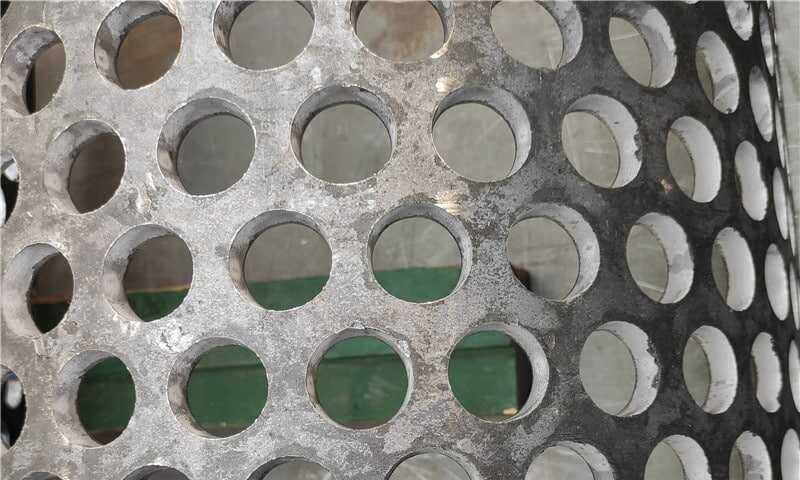
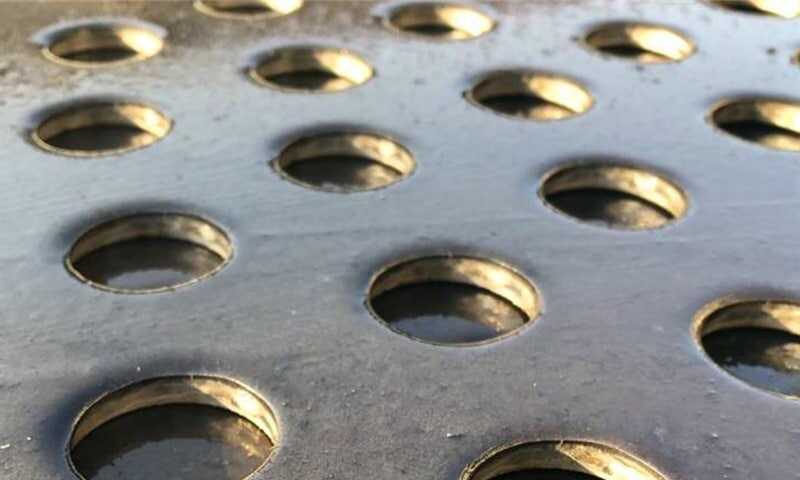
- Hole edges and burrs: Punching or laser-cut holes create local work-hardening, residual stresses and sometimes burrs. These micro-features concentrate abrasion and fatigue. A slightly harder chemistry can help, but a clean, deburred edge often improves life more than raising carbon alone.
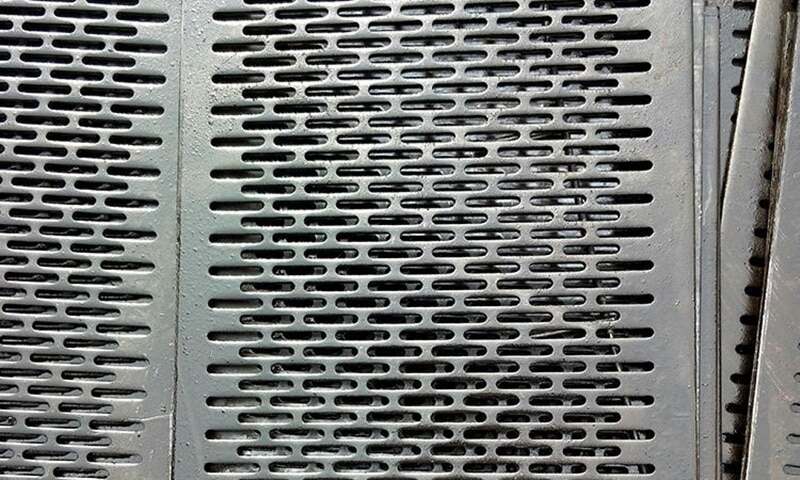
- Open area and hole pattern: Higher open area reduces supporting material cross-section; the same chemistry will perform differently in a 10% open area plate vs. a 60% open area plate because loads concentrate differently.
- Thickness: Thicker plates take longer to wear through. For identical chemistry, doubling thickness often dramatically extends service life.
- Cold work from perforation: The process can locally increase hardness (strain hardening), which can be helpful or harmful depending on the application. Controlled perforation (sharp tools, optimized parameters) gives better, more consistent wear performance.
- Edge finishing and deburring: Mechanical or vibratory deburring and edge rolling reduce stress concentrators and help the plate resist crack initiation, especially in materials with higher carbon where brittleness can be an issue.
Surface treatments and post-processes that amplify wear resistance
If your application needs higher wear performance than base Q345B chemistry provides, consider these options:
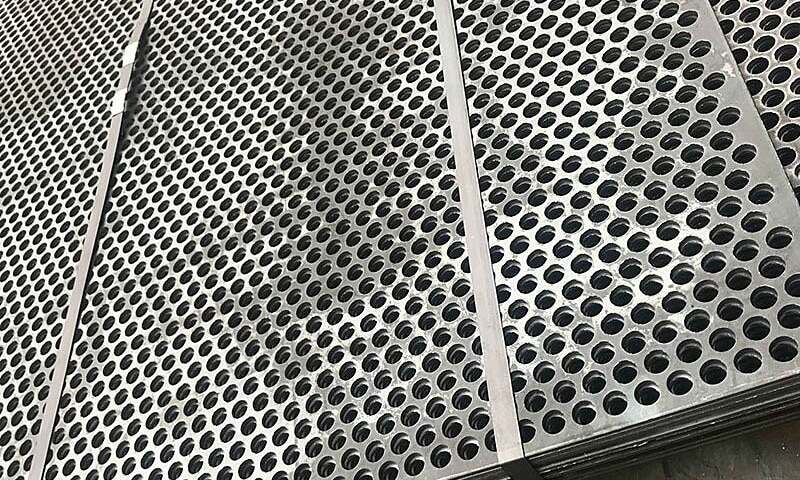
- Hard-facing or weld overlays: Tungsten carbide or chromium-based overlays on high-wear zones can extend life dramatically.
- Carburizing / nitriding: Surface hardening processes raise surface hardness while keeping a ductile core. They require compatible chemistry and process control.
- Coatings: Thermal spray, hard chrome plating, or engineered polymer coatings reduce direct abrasion. Note that coatings can chip if substrate is too brittle.
- Shot peening / cold work treatments: These introduce compressive surface residual stresses that resist crack initiation.
- Heat treatment: Not commonly applied to standard Q345B in mass perforated plate production, but tailored heat treatment (if the chemistry supports it) can increase hardness and wear resistance.
Testing and quality control: how to validate wear performance
A few practical methods to evaluate and validate a perforated plate specification:
- Hardness testing: Rockwell or Brinell tests on representative samples and near the hole edges.
- Abrasion tests: Lab abrasion tests (dry sand/rubber wheel type) simulate sliding wear — useful for comparative evaluation.
- Microstructure inspection: Optical or SEM imaging to check grain size, inclusion distribution and presence of carbides.
- Edge inspection: Magnified checks for burrs, micro-cracks, and deformation after perforation.
- Field trials: A short-duration field test in representative service conditions is often the most reliable indicator.
Practical guidance for specifying Q345B perforated plates for wear applications
- Start with the failure mode: Is the plate losing material to abrasion, suffering impact, or failing from fatigue around holes? That determines whether you prioritize hardness, toughness, or edge integrity.
- Balance carbon with application needs: For heavy sliding abrasion, push carbon/manganese moderately higher — but if welding or forming is frequent, keep them moderate.
- Consider modified grades or microalloyed options if standard Q345B does not meet wear needs; small additions of Cr or microalloying elements can improve wear without major cost increases.
- Control fabrication: Specify punch/die condition, deburring, and edge finish. Many wear problems are cured in the workshop, not the chemistry lab.
- Specify surface treatment where necessary: If downtime is expensive or wear is catastrophic, a welded overlay or surface hardening will often be more cost-effective than thicker base metal.
- Ask for sample testing: Hardness near holes, an example cross-section, and small lab abrasion runs will reduce surprises in service.
Short case example (illustrative)
Imagine a screen plate used in a quarry: with standard Q345B chemistry and a 4 mm thickness, the plate shows edge chipping and faster wear where rock particles strike hole edges. Options that worked in real installations included: switching to a slightly higher Mn content for better work hardening, improving die sharpness and adding vibratory deburring, or applying a localized hard-facing overlay to the most exposed zones. The chemistry-change alone helped life modestly; combining chemistry, fabrication control and surface treatment yielded the best ROI.
Final thoughts
Chemical composition is a foundational factor in the wear resistance of Q345B perforated plates, but it rarely works in isolation. The real gains come from matching chemistry to the perforation geometry, fabrication practices, and targeted surface treatments. When you specify perforated plates for a wear-critical job, treat chemistry, hole-making, edge finish, thickness and post-processing as a single system instead of separate choices.
Ready to specify your Q345B perforated plates?
If you’d like help matching chemistry, thickness, hole pattern and finishing to your wear-critical application, reach out and share your operating conditions (abrasive type, particle size, impact frequency, desired lifetime). We can suggest cost-effective combinations of base chemistry and post-process treatments to extend service life.
Contact: info@perfsheet.com — include your application details and desired quantities for a tailored recommendation.