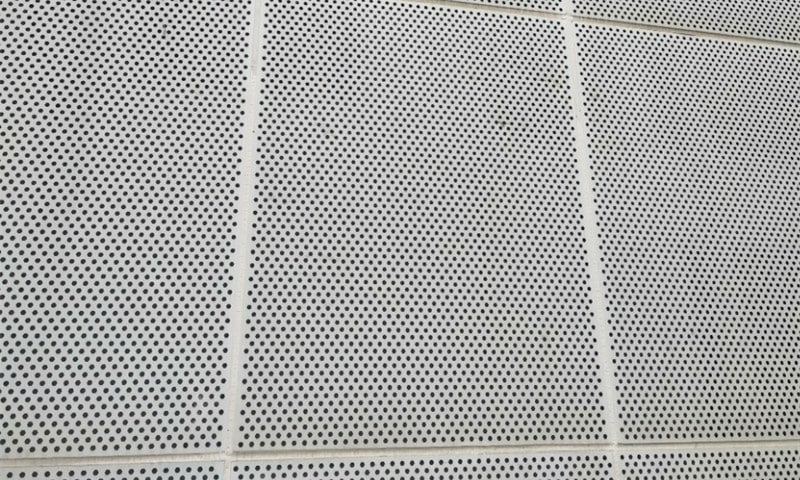
Perforated metal with round holes is a time-tested choice for architectural acoustics. This article breaks down how round-hole perforated metal acoustic panels work, what design variables most influence sound absorption, and practical guidance for choosing and installing panels in real-world projects. The goal is simple: help specifiers and buyers understand why round-hole perforated plates are effective, and which combinations of thickness, hole size, and backing lead to the best results.
How round-hole perforated metal absorbs sound
At its core, a round-hole perforated metal panel acts as a sound-dissipating surface when used with a backing cavity or absorbent core. Sound waves pass through the round perforations and interact with an open-cell material or an air cavity behind the panel. Viscous friction and thermal exchanges inside the holes and porous backing convert acoustic energy into heat, reducing reflected sound and lowering reverberation.
Key mechanisms:
- Viscous losses in narrow passages — air moving through the round holes creates friction.
- Porous material absorption — fibrous or foam backings absorb energy across a broad frequency range.
- Resonant damping — properly tuned cavity depth can emphasize absorption at specific frequencies.
Those mechanisms combine to make round-hole perforated metal acoustic panels a flexible, durable, and visually attractive solution for ceilings, walls, and façade elements.
Main design factors that control absorption
Several design variables strongly affect acoustic performance. Understanding these helps you match a panel to project requirements.
1. Hole diameter and pattern
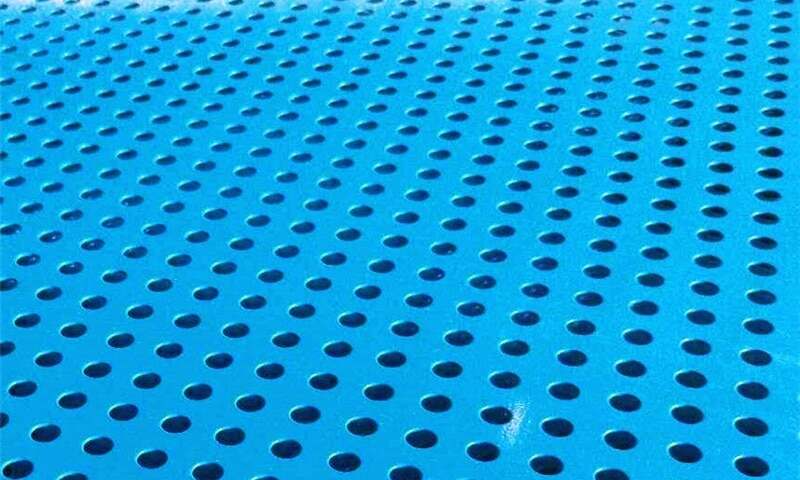
Smaller holes increase viscous friction and can improve absorption at higher frequencies when combined with porous backing. Larger holes tend to pass more energy to the backing and can improve mid-frequency absorption. The hole pattern (staggered vs. straight) affects effective open area and airflow path complexity.
2. Open area (percent open)
Open area — the percentage of the plate surface occupied by holes — is one of the most important parameters. Higher open area generally increases the amount of sound reaching the backing, improving absorption, but it also changes visual transparency and structural strength. Typical ranges for acoustic panels are 10%–40% open area depending on design goals.
3. Panel thickness and material
Material (steel, aluminum, stainless steel, etc.) affects stiffness and durability but has limited direct influence on absorption (most absorption is determined by hole geometry and backing). Panel thickness contributes to mechanical strength and mounting options; thicker plates allow larger spans without additional framing.
4. Backing type and cavity depth
A porous backing (mineral wool, acoustic foam, polyester) provides broad-band absorption. Adding an air cavity between the perforated plate and the backing introduces resonant behavior that can be tuned to improve low-frequency absorption. Typical cavity depths range from 10 mm to 100+ mm depending on low-frequency targets.
5. Edge treatments and mounting
How panels are mounted (directly to wall, with spacers, or on a framing system) changes the effective cavity and therefore acoustic behavior. Sealing edges or leaving gaps influences system resonance and should be considered during installation.
Practical design guidelines (quick reference)
- For speech and general office noise, target moderate open area (15%–25%) with a 20–40 mm porous backing and 20–50 mm cavity.
- For low-frequency control (music rooms, studios), increase cavity depth (50–150 mm) and pair with higher-density backing.
- For exterior façades where weather resistance matters, choose corrosion-resistant alloys and ensure backing is protected with weatherproof membranes.
- To retain structural strength while increasing open area, use thicker plates or smaller staggered hole patterns.
Testing, measurement, and real-world performance
Acoustic performance is measured in laboratories using reverberation-room (Sabine) tests or impedance tube testing for small samples. When evaluating round-hole perforated panels, pay attention to:
- NRC (Noise Reduction Coefficient) — gives an average absorption across mid-frequencies. Useful for quick comparisons, but insufficient alone.
- Absorption coefficients by frequency — the full curve reveals low-frequency weaknesses or resonant peaks.
- Installation conditions — lab results assume certain mounting and backing; real installations often change performance, so on-site verification or conservative design is recommended.
A common approach in specification is to request both lab data (with defined backing and cavity) and contractor verification after installation.
Installation, durability, and maintenance
Perforated metal panels are robust and low-maintenance compared to many soft absorbers. Installation tips:
- Protect the backing from moisture for long life in humid or exterior applications.
- Plan for access panels where systems above ceilings require maintenance.
- Use appropriate fasteners and clips to avoid rattles; secure edges to prevent flapping under airflow or vibration.
- Periodically inspect for dents, corrosion, or accumulated dust in the backing, and clean the visible metal surface with mild detergent as needed.
Round-hole perforated metal acoustic panels combine durability, design flexibility, and measurable acoustic performance. By tuning hole diameter, open area, backing type, and cavity depth, designers can create systems that meet speech intelligibility, reverberation control, and aesthetic goals simultaneously. When specified and installed correctly, these panels provide a long-lasting acoustic solution suitable for offices, auditoriums, façades, and industrial spaces.
If you need help selecting the right round-hole perforated metal acoustic panels for your project — including custom hole sizes, thicknesses, materials, and open-area patterns — email: info@perfsheet.com. Provide your target frequency range, space type (e.g., office, auditorium, façade), and any dimensional constraints, and you’ll receive practical recommendations and available test data.