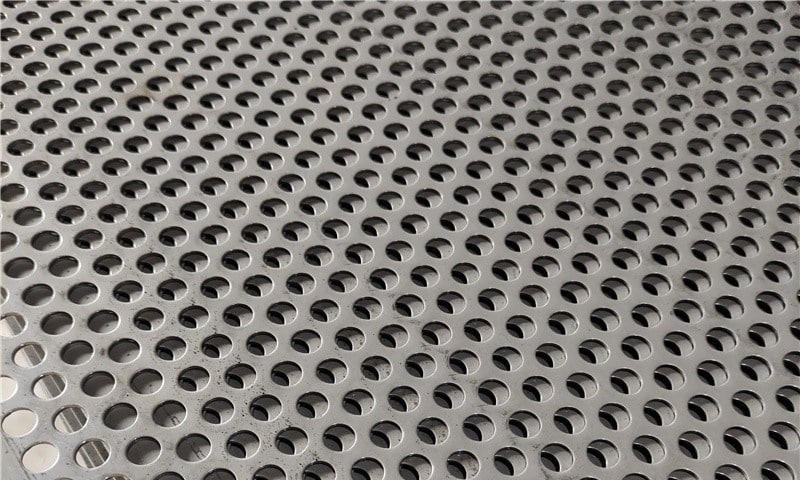
When engineers talk about load-bearing perforated metal, they’re usually balancing two competing demands: keep weight and cost down, while preserving stiffness and safety. I’ve spent years designing and specifying CNC-punched perforated plates for structural and industrial applications, and in practice two variables dominate performance: material thickness and hole layout (pattern + open area). This article walks through the practical engineering logic and buying guidance you need to select the right heavy duty perforated plate for load-bearing use — written for procurement, fabrication, and design teams.

Heavy Duty Perforated Plates
Need a custom heavy-duty perforated plate?
We offer perforated plates with thickness ranging from 2.75mm to 30mm, and up to 6000×1500mm in size, available in round, square, hexagonal, and slotted patterns.
Additionally, we provide precise cutting, surface protection, and other processing services tailored to meet industrial installation requirements.
Feel free to contact us anytime, and we’ll provide a personalized solution that perfectly matches your project needs.
Why thickness is the primary governor of stiffness
Basic concept
Thickness is the most direct control over bending stiffness and strength. All else equal, plate stiffness increases with the cube of thickness for flat plates under bending — small increases in thickness produce large gains in resistance to deflection.
What to consider
- Material grade and yield strength. A 6 mm low-carbon steel plate will behave differently than a 6 mm stainless grade 316 plate because of different yield strengths and elastic moduli. Specify both thickness and grade.
- Effective section after punching. Every punched hole reduces the cross-section available to carry load; thicker plates retain more residual section around holes.
- Typical thickness ranges (practical guide):
- Light structural screening: 2–4 mm
- Medium-duty flooring/guarding: 4–8 mm
- Heavy-duty load support / platforms: 8–12+ mm
These ranges are industry guidance — final selection depends on span, support, and safety factors.
How hole pattern (layout) changes strength and stiffness
Straight vs. staggered patterns
- Straight (inline) pattern: holes align in rows and columns. This pattern simplifies manufacturing and looks tidy, but it produces larger continuous web paths in one direction and can create stress concentration lines.
- Staggered (offset) pattern: holes in adjacent rows are offset. Staggered layouts distribute load paths more evenly and generally preserve higher in-plane stiffness for the same open area.
Open area and pitch
- Open area (%): the fraction of the plate removed by holes. Higher open area lowers weight and improves drainage/airflow but reduces load capacity. For heavy duty plates, aim for a conservative open area — often 10–30% — unless you can increase thickness or add support ribs.
- Pitch and web width: the distance between hole centers determines web width (material left between holes). Minimum practical web widths depend on thickness and hole diameter; too narrow a web leads to deformation during punching and lower structural integrity.

Practical engineering checks (non-proprietary rules of thumb)
- Increase thickness rather than open area reduction when stiffness is critical — a small increase in thickness can buy more stiffness than drastically reducing open area.
- For a given thickness, a staggered pattern with the same open area will usually outperform a straight pattern in bending stiffness.
- When span or concentrated loads are present, add ribs, backing plates, or closer support spacing rather than relying solely on thicker, highly-perforated plate.
Manufacturing and quality considerations that affect in-service strength
Punching method and edge condition
- CNC punching is fast and cost-effective for standard diameters; material work-hardens at the edges and may slightly increase local strength, but punching also creates burrs and localized distortions. If the application demands fatigue life or seamless edges, consider laser cutting or post-punch finishing.
Burr control and deformation
- Burrs and distorted web sections reduce contact surface and can be stress risers. Specify deburring or rolled edges for walkways and bearing surfaces.
Tolerances and repeatability
- Heavy duty applications require tight tolerances for pitch and hole diameter so load paths behave predictably. Ask your supplier for punch tooling specs and capability charts.
Testing, verification, and E-E-A-T signals to request from suppliers
- Material certificates (MTC): chemical composition and mechanical properties.
- Dimensional reports: plate thickness, hole diameter, pitch, and open area measured across production lots.
- Sample load tests or FEA summaries: for high-risk applications request a simple deflection/load curve or a finite element analysis from the fabricator. Even a lab three-point bend or supported span deflection test on a sample plate gives valuable confidence.
- Quality management: ISO 9001 registration, traceability, and in-house inspection procedures are helpful buyer signals.
Selection checklist for procurement (quick, actionable)
- Define the functional requirement (span, live load, point loads, safety factor).
- Choose material grade (carbon vs stainless) based on corrosion and strength needs.
- Select thickness to achieve target stiffness — start with the practical ranges above and iterate with supplier input.
- Choose pattern: staggered for stiffness, straight if simplicity/visual uniformity or tooling constraints drive the choice.
- Limit open area for structural applications; if higher open area is unavoidable, compensate with increased thickness or added stiffeners.
- Request certs, sample testing, and inspection reports before approving production.
Real-world example (illustrative)
A manufacturing plant needed a load-bearing access platform with a 1.2 m unsupported span and concentrated forklift loads near access points. The solution combined 10 mm thick steel perforated plate (open area ~20%) with a staggered hole pattern and welded backing ribs under high-load zones. The result: acceptable deflection under specified loads and reduced weight versus full solid plate — a practical trade that reduced costs while preserving safety.
Conclusion and next steps
When specifying a heavy duty perforated plate for load applications, treat thickness and hole layout as a paired decision: thickness controls the baseline stiffness; layout and open area control how much of that stiffness survives once material is removed. Work with a fabricator early — provide spans, load cases, and environment — and request material certificates and simple test data or FEA to validate the choice. If you’d like, I can convert your load/span data into a short specification sheet to share with vendors.