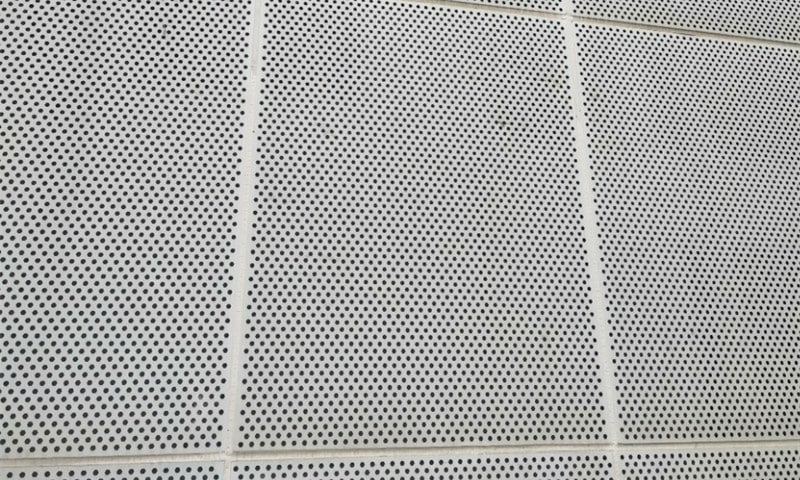
Square hole perforated panels have become a common choice in architectural features, machine guards, ventilation equipment, filtration devices, and many kinds of industrial structures. Their geometric clarity makes them visually clean and mechanically predictable, but the pattern also changes how the sheet handles bending loads. Understanding the bending resistance and load-bearing behavior of these panels helps ensure safer, more efficient, and more cost-effective engineering decisions—whether for a small custom order or for high-volume industrial production.
How the Square Hole Pattern Influences Bending Strength
When a metal sheet is perforated, the removal of material naturally reduces its bending capacity. With a square hole perforated panel, the bending behavior is shaped by three primary factors:
- Hole size and pitch
Larger square openings reduce the effective load-carrying area. A tighter pitch means more removed material and typically a lower bending resistance. For example, a sheet with 10 mm square holes and narrow spacing will bend more easily than one with smaller openings and wider centers. - Open area percentage (porosity)
Open area is one of the most intuitive ways to predict the bending strength. A panel with 20% open area behaves much closer to a solid sheet than one with 50% open area. Lower open area generally means higher resistance to bending. - Material choice
Even with the same perforation pattern, the metal type significantly affects performance. For instance:- A stainless steel perforated sheet will typically carry more bending load than aluminum.
- An aluminum perforated sheet offers lighter weight but lower stiffness.
Because these panels can be custom-made in different thicknesses and metals—from carbon steel to galvanized steel, high-manganese steel, aluminum, and stainless steel—users often tune thickness to compensate for higher open-area ratios.
Why Square Holes Provide More Predictable Load Paths
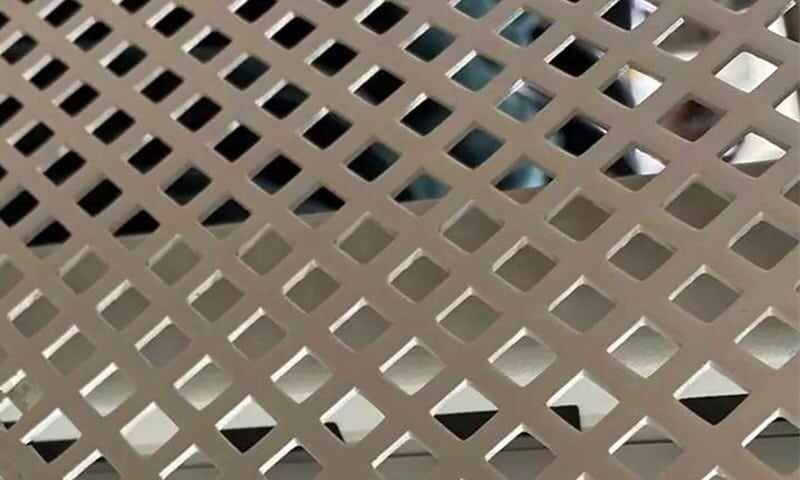
A square hole pattern creates a more uniform load path compared with irregular decorative patterns. Each bridge (the metal between holes) acts like a miniature beam. The way these bridges align vertically and horizontally contributes to consistent bending behavior.
Key points:
- Straight-line bridges improve stiffness
Because square holes create straight, continuous metal ligaments, they provide more predictable resistance when bending across or along the sheet. - More reliable under multi-directional loads
In real installations—such as machine covers or protective screens—loads rarely come from one direction. Square-hole patterns distribute stress more evenly compared to slotted or elongated openings. - Better edge stability
When fabricated with proper margins, square-hole panels resist edge curling better than some round-hole patterns, especially when used in large panels.
In contrast, a round hole perforated sheet tends to distribute stress radially around the hole, whereas a square pattern channels stress more directionally. Neither is universally better; each works well for different design intents.
Thickness and Span: The Two Practical Factors Buyers Often Overlook
In real-world applications, bending resistance is influenced even more by thickness and unsupported span than by hole shape.
1. Thickness
A thicker panel always increases bending resistance—sometimes dramatically. For instance:
- A 2.0 mm stainless steel square-hole sheet may outperform a 3.0 mm aluminum panel.
- Heavier-duty needs—like industrial flooring or protective barriers—often require high-manganese or carbon steel.
If the application involves dynamic loads or vibration, thickness should be increased further for safety.
2. Unsupported span
Even the strongest metal becomes flexible when the span is too wide. When square-hole perforated panels are used as cladding, machine guards, or ventilation screens, the spacing of supports matters just as much as the sheet’s thickness.
Common practical guidelines include:
- Reduce span by adding intermediate framing
- Increase sheet thickness when large panels cannot be avoided
- Use stronger materials (such as galvanized steel perforated plate or carbon steel perforated metal) for heavy-duty spans
These simple adjustments usually improve overall bending performance more than changing hole shape alone.
Comparing Square Holes With Other Common Shapes
A square hole perforated panel is often compared with round, hexagonal, or slotted designs. Here’s how they typically differ in bending behavior:
Square vs. Round Holes
- Square holes remove slightly more material for the same nominal hole size.
- Round holes distribute stress more smoothly around contours.
- Square holes offer higher open area at the same pitch—making them ideal where ventilation is important.
If airflow is the priority, round-hole or hexagonal perforated sheet patterns may also be considered, as they provide high open-area options while maintaining good stiffness.
Square vs. Slotted Holes
- Slotted (or elongated) holes create directional weakness
– very stiff in one direction, more flexible in the other. - Square holes maintain more uniform stiffness in both X and Y directions.
This makes square-hole designs a balanced choice for multi-directional loads.
Square vs. Micro-perforated Panels
If noise reduction or fine filtration is required, a micro-perforated metal sheet performs differently altogether—typically offering excellent acoustic absorption but less bending strength due to extremely small ligaments.
How to Evaluate Bending Performance for Your Project
When selecting a perforated sheet, consider the following checklist:
- Confirm the metal type — strength varies dramatically
- Check thickness — thicker is safer under bending
- Review open-area percentage — higher open area means lower stiffness
- Match hole size to application — too large may reduce load capacity
- Define maximum span — shorter spans prevent excessive deflection
- Consider edge reinforcement — framing, folding, or thickened margins
- Verify surface treatment — galvanized or stainless for corrosion resistance
- Request customized samples if needed — especially for large volume orders
This is why flexible customization—different metals, thicknesses, patterns, porosity levels, and even small-batch orders—matters so much for procurement engineers.
Applications Where Square Hole Perforated Panels Excel
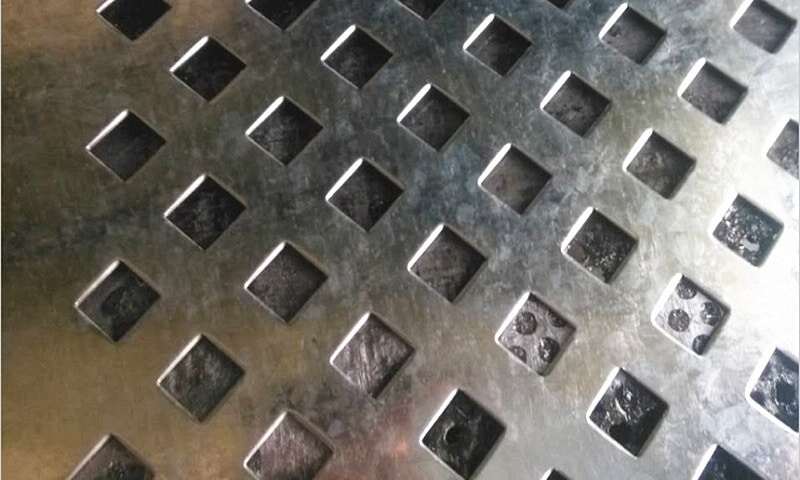
Square hole perforated panels are widely used in:
- Architectural ventilation and façades
- Machinery protective covers and guards
- Acoustic panels (combined with micro-perforations)
- Filtration and separation equipment
- Storage racks and display panels
- Industrial flooring (with reinforced thickness)
- Agricultural machinery and screening systems
When these panels are made in customizable dimensions—whether small quantities or mass-production—they become adaptable for nearly any project.
Ready to Request a Custom Specification?
If you need support designing or selecting square hole perforated panels—or you want to source customized carbon steel, galvanized steel, stainless steel, aluminum, or high-manganese options—we can help with flexible production, fast turnaround, and one-piece minimum orders.
You can reach us directly at:
info@perfsheet.com