Manufacturing Reliable Perforated Safety Grating Plates for Stairs
Industrial stairs are exposed to constant foot traffic, moisture, dust, oil, and outdoor weather. For these applications, perforated safety grating plates are often selected because they combine slip resistance, drainage performance, and structural support.
From a manufacturing perspective, however, product reliability depends on much more than choosing a standard anti-slip hole pattern.
In many projects, installation issues begin with small fabrication deviations. Hole positioning, forming consistency, and dimensional tolerance directly affect welding alignment, assembly speed, and the final visual result.
This article explains how manufacturing precision influences installation performance and how proper punching design can improve both safety and project efficiency.
Why Manufacturing Accuracy Matters for Stair Grating Plates
Safety grating plates are usually installed as part of welded stair systems or bolted modular assemblies.
Unlike flat perforated sheets used for decorative applications, stair plates must fit within structural framing with limited adjustment allowance.
Typical fabrication issues include:
- Inconsistent plate width after punching
- Deviation in formed side channel angles
- Hole distortion near bending lines
- Uneven plate flatness after punching
- Misalignment between tread plates and support frames
Even minor dimensional variation can create problems during site installation.
For example, if formed side flanges are not consistent, welders may need to force alignment. This can increase installation time and may affect the final stair geometry.
For projects with repeated stair modules, manufacturing consistency becomes especially important because accumulated deviation can affect the full assembly.


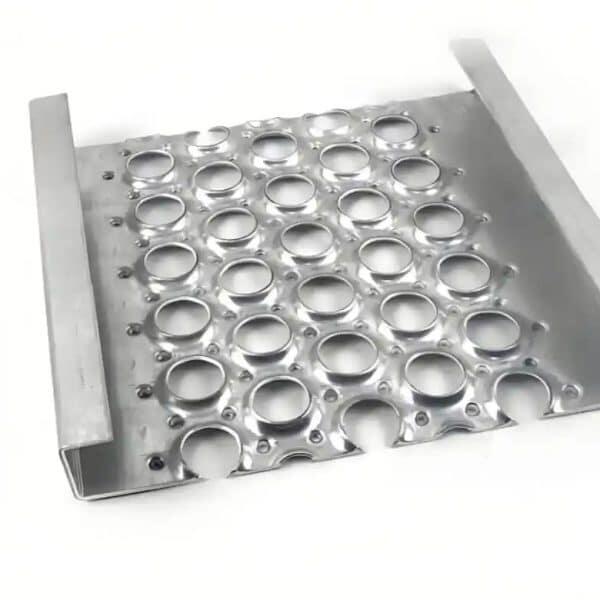
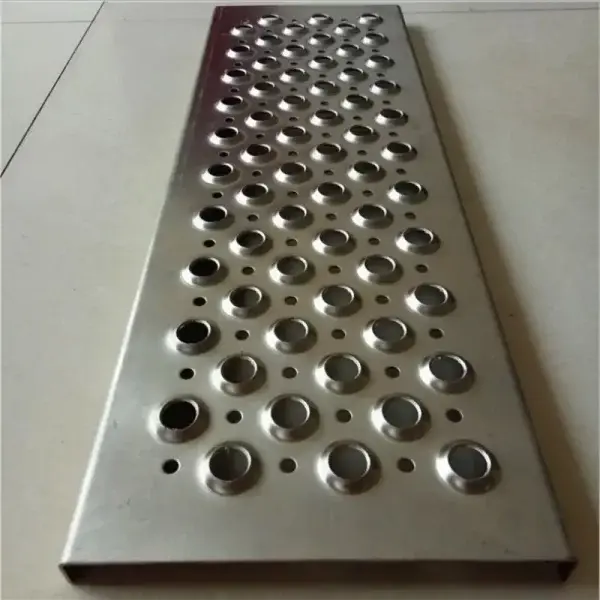
Perforated Safety Grating
Perforated safety grating plates for industrial stairs require consistent punching accuracy, stable flatness, and reliable forming control. At Perfsheet, we manufacture anti-slip stair plates with customized hole patterns, bending options, and reinforced fabrication details to support welding and field installation. Share your stair layout, load requirements, and fabrication drawings for production evaluation and quotation.
How Punching Layout Affects Welding and Installation
The punching pattern is not only related to slip resistance.
It also affects how the plate behaves during fabrication.
Hole Density Influences Material Stability
Higher open area generally improves drainage and visibility.
However, excessive perforation can reduce local rigidity.
This may lead to:
- Sheet deformation during punching
- Distortion during bending
- Reduced dimensional stability during welding
The ideal open area depends on:
- Material thickness
- Plate span
- Support spacing
- Required load conditions
- Edge reinforcement design
In many industrial stair projects, balancing slip performance and structural stability is more practical than maximizing open area.
Edge Margin Is Critical for Forming Accuracy
One common design mistake is placing perforations too close to bending lines.
When this happens, material around the bend zone becomes weaker, which may cause:
- Irregular bend radius
- Edge cracking in some materials
- Angle inconsistency
- Reduced flange stiffness
A properly designed solid margin near the bend line helps maintain forming precision.
The exact margin depends on:
- Material grade
- Thickness
- Punch shape
- Forming radius
- Tooling setup
This is why fabrication drawings should always be reviewed before production.
Optimizing Hole Design for Better Visibility and Safety
For industrial stairs, perforation layout affects how operators visually interact with the stair system.
This is especially important in elevated platforms, offshore facilities, and process plants.
Controlled Visibility Improves User Confidence
Perforation patterns that are too visually dense may create an uncomfortable sense of openness.
Patterns that are too closed may reduce drainage and trap debris.
Many projects aim for a balanced visual effect that provides:
- Clear footing visibility
- Adequate drainage
- Reduced visual obstruction
- Comfortable stair perception at height
The punching scheme should support both practical use and operator comfort.
Directional Hole Orientation Can Improve Traction
Certain anti-slip perforation designs create directional traction.
This can improve performance when installed with correct orientation.
Manufacturing teams typically confirm:
- Walking direction
- Plate installation orientation
- Drainage direction
- Supporting frame geometry
This review helps avoid installation mistakes later.
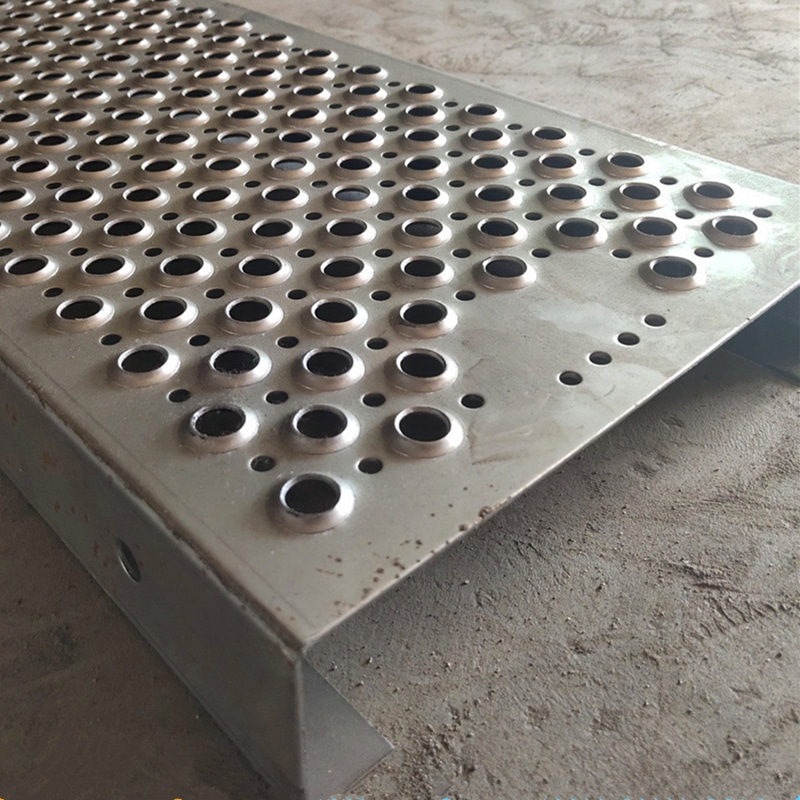
Forming Control for Consistent Stair Plate Fabrication
After punching, many stair grating plates require forming operations such as:
- Side channel bending
- Nose edge forming
- Reinforcement flanges
- Weld preparation edges
Each operation introduces dimensional variables.
Tooling Setup Must Match Perforation Geometry
Punch pattern and forming tooling must work together.
If tooling pressure is not properly distributed, perforated zones may deform during bending.
Production control often focuses on:
- Punch-to-bend sequencing
- Tool clearance selection
- Forming pressure consistency
- Flatness verification after bending
These controls help reduce fit-up problems during stair assembly.
Material Selection Also Influences Fabrication Precision
Common materials include:
Carbon Steel
Often selected for industrial projects with hot-dip galvanizing.
It offers good forming characteristics in many cases.
Stainless Steel
Suitable for corrosive environments.
It may require closer forming control because springback behavior often differs from carbon steel.
Aluminum
Used where weight reduction is important.
It can require different punching and forming parameters depending on alloy temper.
Material behavior should be considered during drawing review rather than after tooling is prepared.
What Buyers Should Confirm Before Ordering
For perforated safety grating stair plates, clear RFQ information helps avoid production delays.
Recommended details include:
Stair Application
Specify whether plates are for:
- Straight industrial stairs
- Platform transitions
- Offshore access systems
- Maintenance walkways
- Outdoor utility access
Fabrication Requirements
Include:
- Material grade
- Thickness
- Plate dimensions
- Hole pattern
- Open area preference
- Bend details
- Surface treatment
- Welding preparation requirements
Assembly Method
Confirm whether plates will be:
- Welded directly
- Bolted
- Installed into prefabricated frames
This affects manufacturing tolerances and edge design.
Reliable Stair Plate Manufacturing Starts with Drawing Review
Perforated safety grating plates perform well when punching design, forming control, and installation requirements are considered together.
From a manufacturing standpoint, the goal is not simply to produce punched metal.
The goal is to deliver components that fit correctly, weld efficiently, and perform reliably in service.
Early drawing review often helps identify design adjustments that improve fabrication stability and simplify installation without changing project intent.