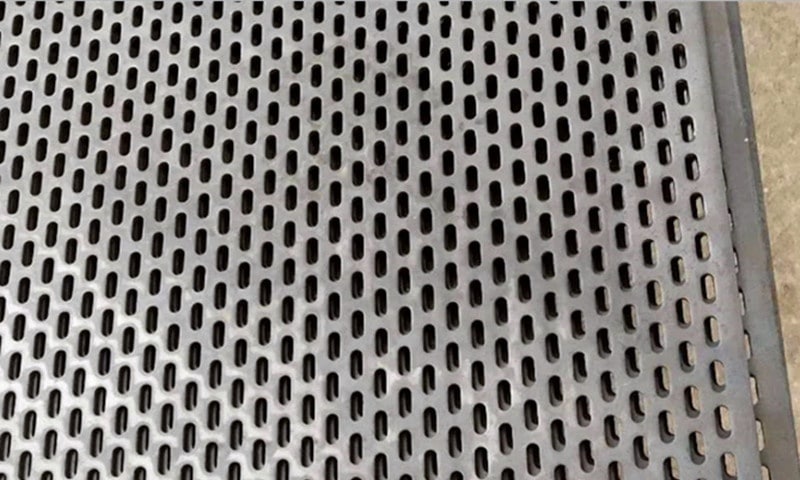
Why Hex Perforation Performs Differently from Round Hole Patterns
When engineers compare perforation layouts, open area is often the first number they check.
But panel performance is not determined by open area alone.
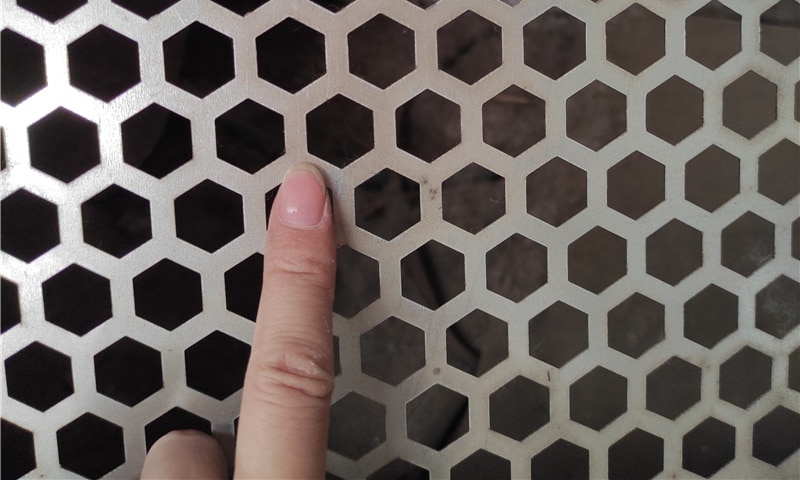
Hole geometry changes how remaining metal distributes stress across the sheet. This is where hex perforated carbon steel behaves differently from standard round-hole layouts.
The honeycomb pattern creates shorter ligament spans between openings. In many cases, this helps distribute load more evenly across the panel surface.
That matters when the sheet will be used for:
- Machine guards
- Equipment enclosures
- Ventilated covers
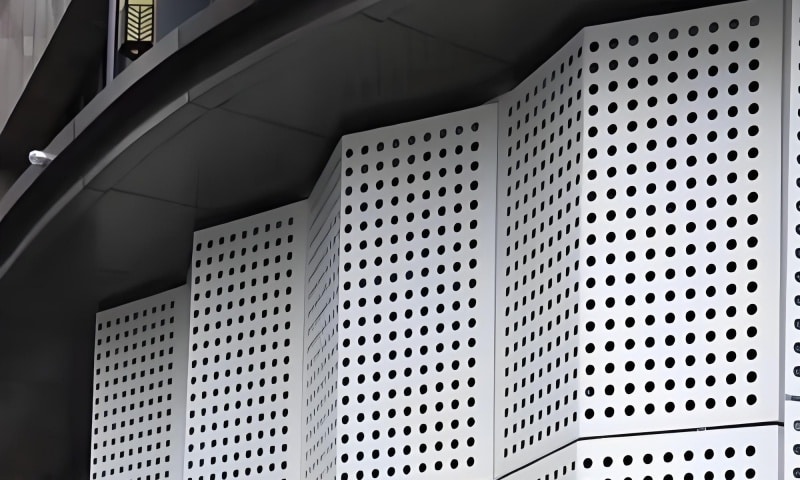
- Decorative architectural screens
- Partition panels requiring moderate rigidity
A panel with similar open area but a different hole shape may respond very differently during handling, forming, or installation.
How Honeycomb Geometry Affects Load Distribution
More Continuous Material Paths
The hexagonal layout creates repeating angular support paths.
This allows force to transfer across multiple directions instead of concentrating along straight rows.
In practical fabrication, this often provides:
- Better resistance to localized flexing
- Improved dimensional stability during handling
- More uniform visual tension across large panels
This is especially useful for honeycomb perforated panels installed in wide unsupported spans.


Hexagonal Hole Perforated Metal Sheets
Hex perforated carbon steel sheets offer a practical balance between open area, panel stiffness, and clean visual effect. For guards, screens, and fabricated covers, tooling accuracy and edge finishing directly affect fit, safety, and final appearance. We supply custom honeycomb perforated panels with controlled deburring, forming support, and fabrication review based on your drawing. Send your RFQ for pattern evaluation and production advice.
Open Area vs Structural Stability
Higher open area improves airflow and visibility.
However, increasing open area also reduces remaining material.
With hex perforation, designers can often achieve strong visual openness while maintaining acceptable stiffness, depending on:
- Sheet thickness
- Hole size
- Pitch spacing
- Carbon steel grade
- Edge frame design
- Whether the panel is flat or formed
There is no universal “ideal” open area.
The correct balance depends on the panel’s final application.
For example:
Protective guard panels usually prioritize stiffness and impact resistance.
Decorative screens may prioritize transparency and visual depth.
Where Hex Perforated Carbon Steel Works Best
Equipment Guards and Industrial Covers
For machine guarding, hex perforation provides airflow while preserving panel integrity.
Its geometric structure also gives a technical appearance often preferred in industrial environments.
Typical applications include:
- Fan guards
- Ventilation housings
- Protective machine panels
- Generator covers
In these cases, deburring is especially important because operators may regularly contact panel edges.
Architectural Decorative Screens
Architects often choose honeycomb perforation for visual rhythm.
The pattern creates:
- A clean modern appearance
- Controlled transparency
- Interesting light diffusion
- A structured visual texture
For interior and exterior screens, panel flatness becomes critical.
Large sheets with aggressive open area may distort during fabrication if tooling sequence is not properly controlled.
Why Deburring Matters More Than Many Buyers Expect
A honeycomb pattern creates many corner transitions.
These corners can retain sharper burr formation compared with round-hole perforation.
This affects:
- Operator safety
- Surface touch quality
- Powder coating consistency
- Visual finish under direct lighting
After punching, deburring may involve:
Mechanical Edge Refinement
This removes raised burrs and improves handling safety.
It is commonly used for:
- Equipment guards
- Access panels
- Functional industrial parts
Surface Preparation Before Coating
For painted or powder-coated panels, proper burr removal helps improve coating consistency.
Residual sharp points can affect finish uniformity in some cases.
This is particularly important for architectural applications where reflected light highlights surface irregularities.

Forming Hex Perforated Panels Requires Planning
Buyers sometimes assume perforated sheets can be bent like solid sheet metal.
That is not always the case.
With open area perforated carbon steel sheet, bending performance depends on how much solid material remains in the bend zone.
Before fabrication, manufacturers typically review:
Bend Direction Relative to Pattern
Bending across perforation rows may behave differently from bending parallel to them.
Edge Margin Requirements
A solid border often improves forming stability.
Without enough unperforated edge material, deformation may occur during bending.
Tooling Radius Selection
Punch pattern density can influence material response during forming.
In many cases, larger bend radii help reduce distortion.
What to Include in an RFQ for Honeycomb Perforated Panels
To avoid production delays, buyers should provide:
Pattern Details
Specify:
- Hex hole size
- Center-to-center pitch
- Open area target if applicable
Material Information
Include:
- Carbon steel grade
- Sheet thickness
- Surface finish requirements
Fabrication Requirements
Clearly note:
- Flat sheet or formed part
- Deburring expectations
- Coating requirements
- Critical visible surfaces
If appearance matters, identifying the show face is helpful during production planning.
Choosing Honeycomb Patterns for Performance, Not Just Appearance
The honeycomb layout is popular because it looks clean and modern.
But its real value is functional.
When properly specified, hex perforated carbon steel can offer a practical balance of:
- Strength
- Ventilation
- Visual openness
- Fabrication flexibility
The best results usually come from reviewing perforation geometry together with forming, finishing, and handling requirements before production begins.
That early discussion often prevents costly adjustments later.